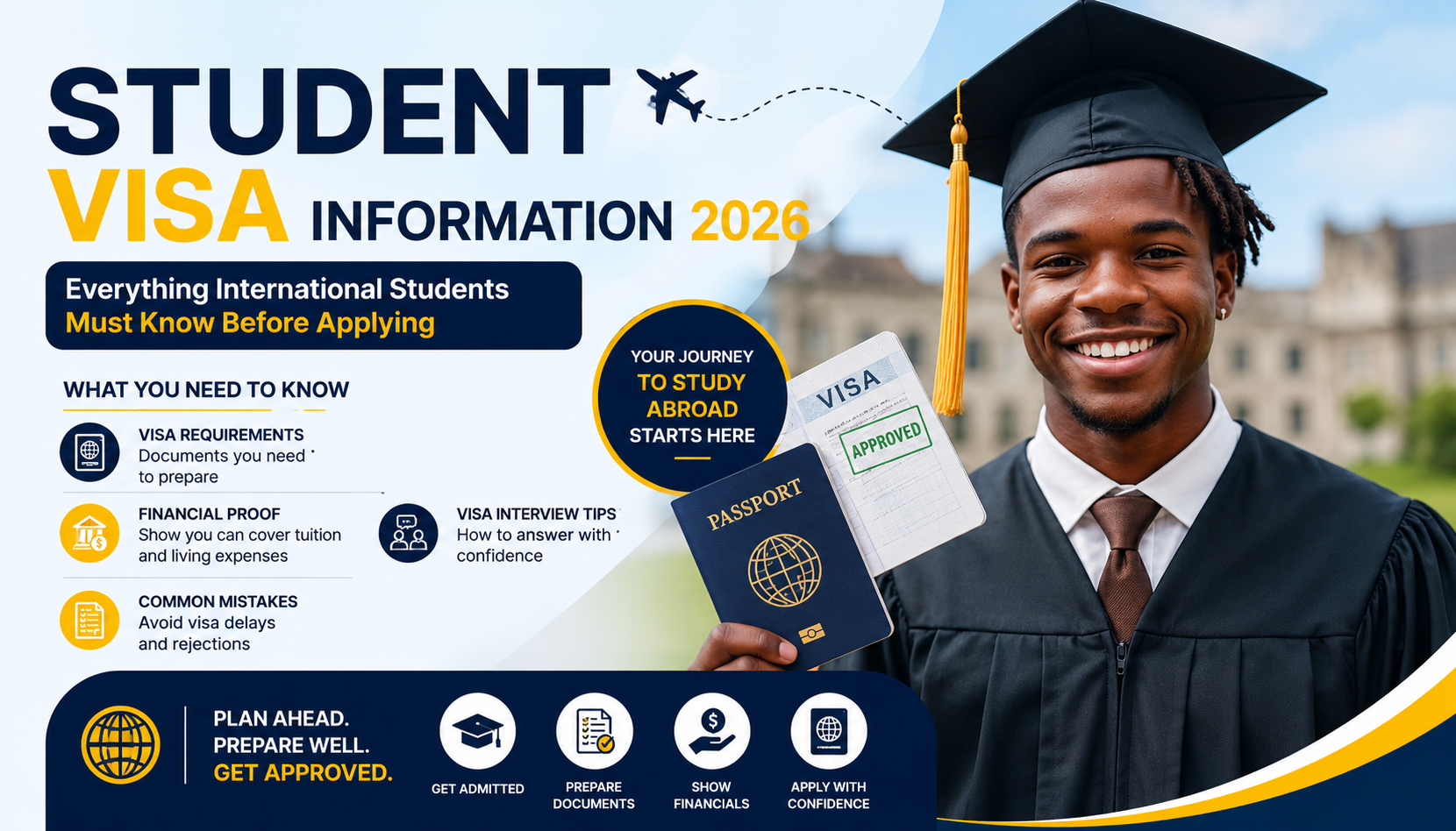
Getting admission is exciting.
Then reality hits.
You suddenly realize the hardest part may not be the university application — it’s getting the student visa approved.
Every year, thousands of international students receive admission offers but still get denied visas because they misunderstood the process, submitted weak documents, or couldn’t convince immigration officers they were genuine students.
The painful part? Many of those refusals could have been avoided.
If you’re planning to study abroad in 2026, this guide breaks down exactly how student visas work, the common mistakes applicants make, and what immigration officers actually look for behind the scenes.
👉 CLICK HERE NOW TO SEE HOW TO APPLY
What Is a Student Visa?
A student visa is official permission that allows you to live and study in another country for a specific period.
Without it, your university admission alone means nothing.
Each country has its own visa system:
- Canada — Study Permit
- United States — F-1 Visa
- United Kingdom — Student Visa
- Australia — Subclass 500 Visa
- Germany — German Student Visa
The requirements may differ, but immigration officers generally assess the same core things.
What Immigration Officers Really Want to See
This surprises many applicants.
Visa officers are not only checking documents.
They’re asking themselves one question:
“Is this person genuinely going abroad to study?”
That single question affects everything.
They examine:
- Financial stability
- Academic background
- Travel history
- Study plans
- Career goals
- Country ties
- Consistency in documents
A strong application tells a believable story.
A weak application raises doubt immediately.
Basic Student Visa Requirements
Most countries request similar documents.
Here’s what you’ll likely need:
Valid International Passport
Your passport must usually remain valid throughout your study period.
University Admission Letter
This proves you’ve been accepted into an approved institution.
Proof of Funds
One of the most important requirements.
You may need to show:
- Bank statements
- Sponsor documents
- Scholarship letters
- Tuition payment receipts
Countries like Canada and United Kingdom are especially strict about financial proof.
English Language Results
Depending on the country:
- IELTS
- TOEFL
- PTE
- Duolingo
Medical Examination
Some countries require immigration medical tests.
Police Clearance Certificate
Used to verify criminal history.
Why Student Visas Get Rejected
This is where many applicants struggle.
Here are common reasons for refusal:
Weak Financial Proof
Large sudden deposits often trigger suspicion.
Immigration officers prefer consistent financial history.
Poor Study Plan
If your chosen course doesn’t match your previous education or career path, you must explain why clearly.
Inconsistent Information
Even small inconsistencies can become major problems.
For example:
- Different dates
- Conflicting financial details
- Incorrect employment history
Low Confidence During Interviews
Some embassies conduct interviews to evaluate credibility.
Nervousness alone won’t ruin your application — but unclear answers can.
Countries With Popular Student Visa Pathways in 2026
Canada
Canada remains one of the most attractive destinations because of:
- Post-graduation work permits
- Immigration opportunities
- High-quality universities
- International student-friendly policies
Australia
Australia allows students to work while studying and offers several long-term residency pathways.
Germany
Germany attracts students with low or tuition-free education in many public universities.
United Kingdom
The UK’s Graduate Route now allows eligible students to remain and work after graduation.
How Much Bank Balance Is Required?
This depends on the country and city.
Generally, immigration wants proof that you can:
- Pay tuition
- Cover accommodation
- Handle living expenses
Approximate yearly financial proof requirements:
| Country | Estimated Minimum Funds |
|---|---|
| Canada | CAD $20,000+ |
| UK | £12,000+ |
| Australia | AUD $24,000+ |
| Germany | €11,000+ |
These figures can change yearly.
Student Visa Interview Tips
Visa interviews scare many applicants unnecessarily.
Officers mainly test:
- Confidence
- Honesty
- Clarity
- Genuine intention
Questions may include:
- Why did you choose this university?
- Why this course?
- Who is sponsoring you?
- What are your future plans?
Short, confident answers work best.
Memorized robotic responses usually fail badly.
Can Students Work While Studying?
Yes — many countries allow international students to work part-time.
Examples:
- Canada — up to 24 hours weekly during academic sessions
- Australia — work rights for eligible students
- United Kingdom — limited work hours during studies
This helps students support living expenses and gain work experience.
Best Advice for First-Time Applicants
Don’t rush your visa application.
A strong visa file is carefully prepared, consistent, and believable.
Spend time on:
- Financial documents
- SOP or study plan
- Course selection
- Application accuracy
And most importantly — apply honestly.
Immigration systems are far more sophisticated today than many people realize.
Final Thoughts
A student visa can become the bridge between your current reality and a completely different future.
For many students, it opens doors to international careers, permanent residency pathways, and opportunities that extend far beyond the classroom.
But approval rarely happens by luck.
Strong preparation matters.
Consistency matters.
Timing matters.
Treat your application seriously from the beginning, and you’ll already be ahead of many applicants.